
“This is the Night” – The Return of the Easter Vigil Light
Watch Easter Vigil Livestream

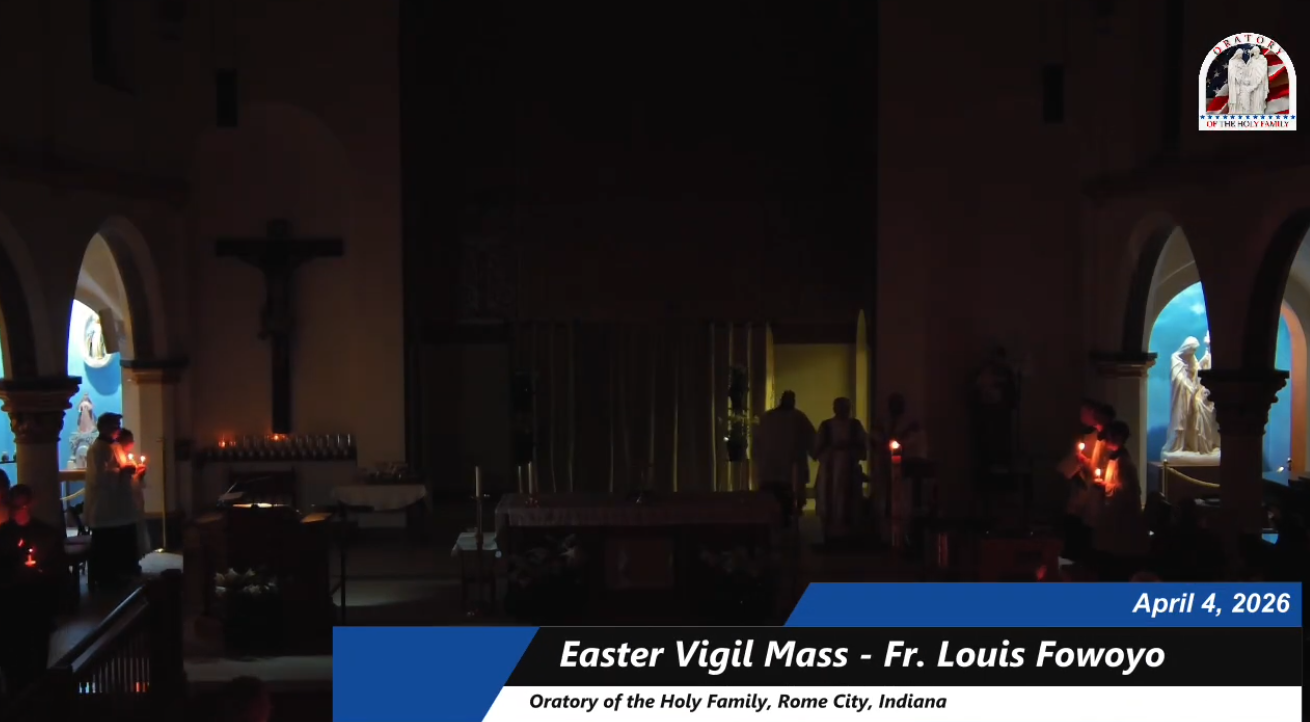
On April 4th, the Easter Vigil was celebrated in the Oratory of the Holy Family for the first time in over 50 years. Thanks to ongoing renovations happening at Saint Gaspar parish down the road, the Oratory has become a host for all their Masses. This means daily Masses, weekend Masses, funerals, weddings, and holidays are all being celebrated within our oratory walls again. What a grace it has been to witness so many sacraments return to this old building! Many people have come to learn more about the Oratory since we began hosting the parish in the fall of 2025. 

Father Louis Fowoyo, the pastor of Saint Gaspar and the chaplain at the Oratory of the Holy Family, was the celebrant for the Easter Vigil Mass. The darkness which begins the liturgy is soon dispelled by the light of the Paschal candle and candles of the congregants, followed by the oratory lights. Then the ancient hymn, the Exsultet, is proclaimed (text found here). Father Louis and parishioner Tim Worman sang the Exsultet together. This was then followed by a series of readings and Psalms, the triumphant return of the Gloria and Alleluia, and then the Gospel. 

Father Louis preached on the great blessing of celebrating a peaceful Easter, mentioning modern-day martyrs in various parts of the world, including his home country, Nigeria. He also thanked those who helped prepare the liturgy and those who have been teaching OCIA and preparing candidates for reception into the Church, saying that he has also been learning from their instruction and their faithful witness. He reflected on the story of Mary Magdalene coming to the tomb, heavy-hearted and grieving, but leaving with the joy, hope, and lightness of the Resurrection; how often, Father said, is this the story of every human heart? 

“My dear brothers, my dear sisters, the empty tomb is not just a sign of absence but the beginning of a new presence, the beginning of life, the beginning of life that is given. So the empty tomb is the life taken away in order that life might be given to us. And so that is what it means. As Peter and the beloved disciple run toward the tomb, we see a journey of both urgency and wonder because they were told the news. They were asked to go see that the tomb is empty. Peter and John were rushing. They wanted to see it.” – Excerpt from Fr. Louis Fowoyo’s homily

His message continued with a challenge to be like the Apostles, particularly John, believing even amidst the confusion and uncertainty, and trusting beyond what we can see. He concluded by talking about how the light of Christ, the dawn of that Easter morning, changes everything, just as the lights of the candles and the church changed our perspective from the darkness that began the liturgy; “Now the movement from darkness to light reflects the journey of the disciples from confusion to belief, from sorrow to hope, from betrayer to trust.” He challenged all gathered to make this our story, to be a people who hope, who believe, and who live as people of the resurrection. 

“My dear brothers, my dear sisters, we are Christians and so we must embrace this faith. Easter is not just an event we remember. It is a reality we are invited to live in. We live it every day.” -Excerpt from Fr. Louis Fowoyo’s homily. 

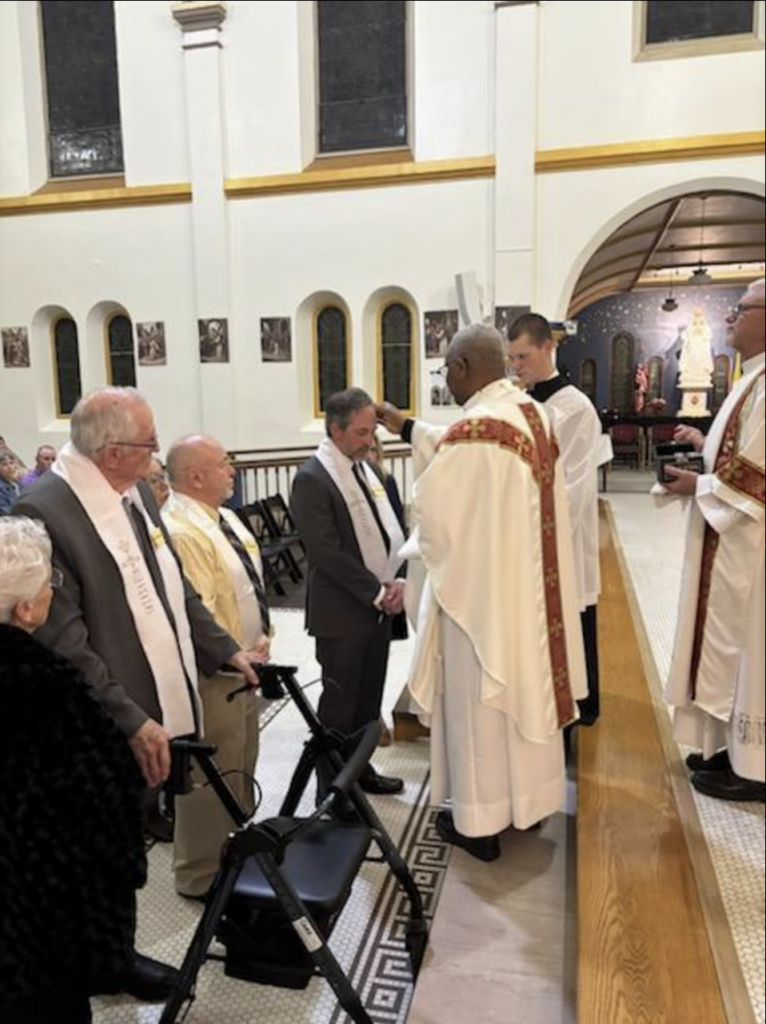
The Mass continued with the singing of the Litany of the Saints; Father joked at the beginning of the homily that it would be the best they’ve ever heard it sung. This was followed by the reception of three men into the fullness of the Catholic faith, one of whom received Baptism and all three of whom received Confirmation and Holy Communion. The whole congregation renewed their Baptismal vows, and the Mass continued as usual with the Eucharistic prayer, communion, and the concluding rite. 

After 50 years of no public Easter Masses, we could not have asked for a better return of Easter at the Oratory. Light, song, new members, and Resurrection joy shared by all; what a night! 

Rite of Confirmation

Up until 1957, when the local parish built its church and established St. Gaspar Parish, the parish Masses were celebrated at the Oratory, which was then the Mother of Mercy Chapel.

When the parish left for their new home in 1957, it is most likely that there were no Confirmations at the Chapel until Easter 2026, nearly 70 years later. 

So presumably, these three men were the first in 70 years to be confirmed here. And we can say with certainty, the first Confirmations ever under the gaze of Our Lady, the Immaculate Virgin, Patroness of America!

The Easter celebrations continued the next morning:

Read More

We Are Preparing for Your Visit

Stop by this Summer

We are busy getting ready for Our Lady’s children.  The grounds are being prepared, repairs are wrapping up, and improvements are in the works. But it is all pointless without you!

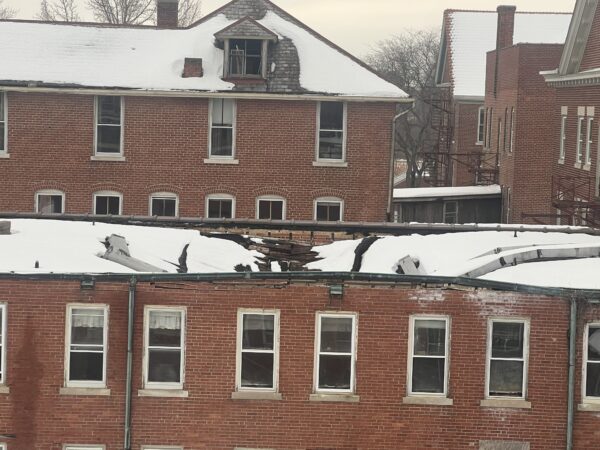
Dining Room Tear Down

A building in the process of collapse is being taken down for safety. It was an extension to the dining room added around 1955.

Plaza Repair

On the south Plaza, a retaining wall was failing.  Not only was it eating away at the plaza, but it was also a safety concern, causing us to close the path below.   Over the winter, the wall was replaced and will hopefully last 100 years, just like the last one

BEFORE

Water Fount Upgrade

We inspected the plumbing, replaced the return line, and upgraded the pump that lifts water the last 10 feet and supplies it to the spickets.  Benefit: more reliable, faster flow.  Come get the healing water.

WaterFountPlumbing

Celebration Tent

The tent is up and ready for meals, community, fellowship, and rest.

Two New Bathrooms

We are finishing two new bathrooms, accessible from the back of the Oratory.  Appropriate for families with young children.  The location prevents that awkward trip to the bathroom that goes right past the ambo during the Father’s sermon!

Everything we do at the Our Lady, Patroness of America Center is for you, Our Lady’s children.

All we are missing is you.

Our Lady looks forward to welcoming you!

Read More

St. Joseph’s Lily, Gives Meaning to Our Lady of America’s Lily
What is the significance of the lily? It actually matters quite a bit. In Catholic art and tradition, the lily symbolizes a deeper reality. In Catholic culture, the lily is known by many names, such as the Annunciation Lily, Easter Lily, Madonna Lily, and Resurrection Lily, each with a different meaning. Today, let us explore the meaning behind the lily associated with St. Joseph, often called the Lily of Purity. Let’s examine how the lily of St. Joseph teaches us about the Holy Family.

In this article, I aim to explore how the lily is used to symbolize the eternally significant events that established the Holy Family and what they mean for us.

The certainty of Divinity entering into humanity in the person of Jesus Christ was established by eternal Divine Decree before the creation of humanity.  But the knowledge of when this was to occur was unknown to the Angels and all creation, reserved only to the Holy Trinity.  It was at the Immaculate Conception of Our Lady that the Angels knew that it was imminent, for she was Full of Grace, and without stain. She is the perfection of humanity.  At her conception, she was preserved from the stain of sin and received the fullness of God’s gifts destined for humanity.

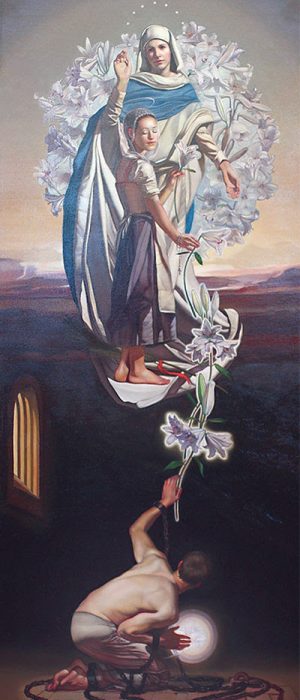
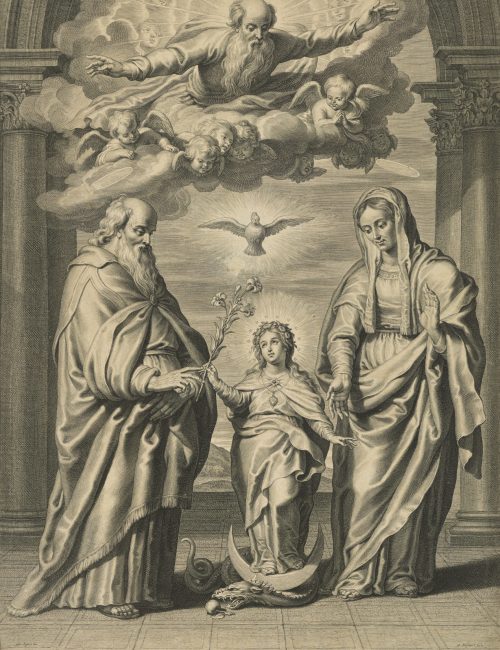
Mary offers the lily to her father, Saint Joachim

It is clear from this understanding that Our Lady has no need to possess the lily of purity, for she is Immaculate.  But she does have a desire to share the fruit of her gifts, and as such, in Catholic art, she is sometimes portrayed as the dispenser of lilies to us, her children. (An example can be found below in this image of Saint Maria Goretti)

Saint Maria Goretti gifts the lily to her murderer, Alessandro Serenelli

In Catholic art, Our Lady, when depicted with a lily, holds it not in a way of possession but in a way of offering. Why is that? The lily symbolizes the gift of purity, yet Our Lady does not need to be made pure; she is far more than that—she is Immaculate! Purity results from purification, which means being stained and then cleansed, but Immaculate means never stained at all. It’s important to understand that the lily does not represent Our Lady’s nature, but it does symbolize the nature of St. Joseph. So, when we see Our Lady with a lily, it signifies an offering—a gift. When we see Saint Joseph with a lily, it indicates possession of that gift. 

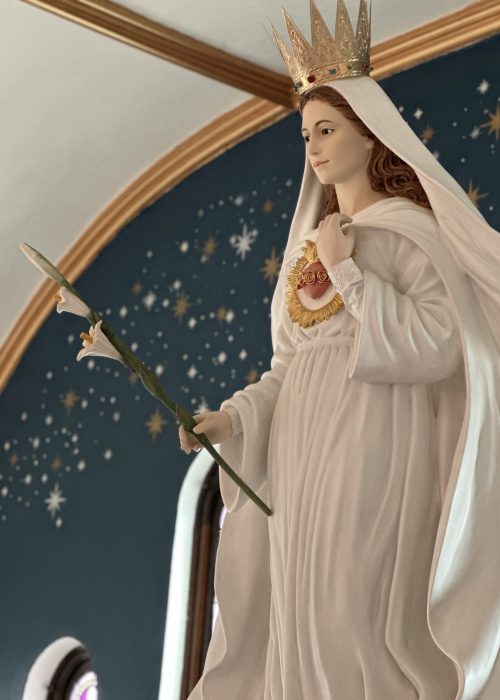
The lily that St. Joseph holds is called the Lily of Purity. But what Our Lady teaches us through devotion to her, as the Immaculate Virgin, Patroness of America, is that it represents more than just the gift of purity; it symbolizes participating in the life of the Holy Family. Here at the Our Lady, Patroness of America Center, we have started referring to the lily she holds and offers as the Lily of the Holy Family. The statue of Our Lady, Patroness of America (as given to Sr. Mary Ephrem), in the Oratory of the Holy Family depicts her offering us this lily and inviting us to share in the life of the Holy Family in a mystical, intimate way. 

Statue of Our Lady offering the lily

This way is not new. It is deeply rooted in Scripture and the Holy Sacraments of the Church, though most Catholics do not realize it. Our Lady aims to bring her children a deeper understanding and participation in this mystery of God’s Church. Recognizing and responding to Our Lady’s call is the essential first step in helping her lead the world to peace.

To understand the lily Our Lady offers us, we first need to understand the lily that St. Joseph holds. How did St. Joseph receive his lily? It was through a series of gifts given early in his life, culminating in his betrothal to the Blessed Virgin Mary. The lily he holds symbolizes the completion of the gifts given to him so he could receive his son as the worthy Virgin-Father of the Christ Child.

About a week after Our Lady came to Sr. Mary Ephrem in Rome City, in September of 1956, St. Joseph came to Sister in a purported locution and revealed some very significant details, revealing the first gifts he was granted immediately after his conception.  Here is what he said to Sr. Mary Ephrem.

In early October, 1956, about a week after Our Lady’s first appearance, St. Joseph, though I did not see him at this time, spoke to me the following words:

“It is true my daughter, that immediately after my conception, I was, through the future merits of Jesus and because of my exceptional role of future Virgin-Father, cleansed from the stain of original sin.

“I was from that moment confirmed in grace and never had the slightest stain on my soul. This is my unique privilege among men. “My pure heart also was from the first moment of existence inflamed with love for God. Immediately, at the moment when my soul was cleansed from original sin, grace was infused into it in such abundance that, excluding my holy spouse, I surpassed the holiness of the highest angel in the angelic choir.

Here we see St. Joseph receiving some very special gifts that laid the foundation for him to become the worthy Virgin-Father of the Redeemer. Essentially, he was baptized (saved) in the womb through the future merits of Jesus Christ, and then, by an abundance of grace and love for God, he was able to avoid all sin, even though his free will was fully in place. 

Although this is not a Dogma of the Church, it reflects a consensus among theologians and is mentioned by saints and mystics. Many arguments support this, based on the Church’s tradition and logic.

St. Joseph was being prepared from birth to be the Virgin-Father of Jesus! But this preparation was not complete.  That did not happen until the betrothal to Our Lady, the Immaculate Conception. 

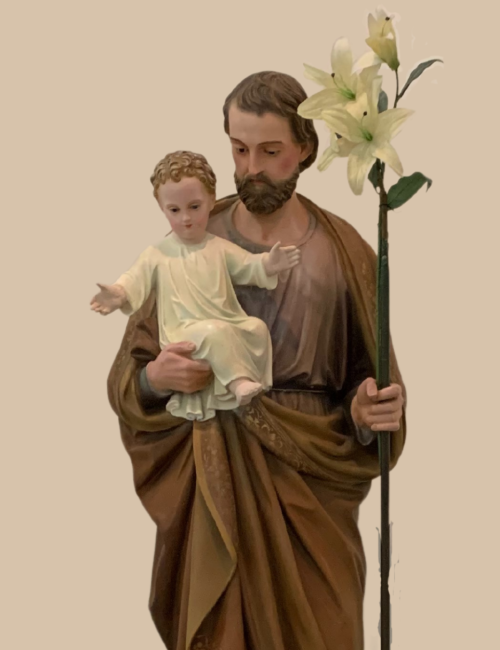
By that time, with Our Lady’s parents deceased, the temple elders assumed responsibility for arranging her marriage. Venerable Sr. Mary of Agreda, in the Mystical City of God, recounts that when the potential suitors gathered, St. Joseph’s staff sprouted a budding lily, signaling to the elders that he was God’s chosen one for the role of the Virgin Mary’s spouse. Their marriage elevated him to the highest dignity in all creation, second only (by a large margin) to Our Lady, the Immaculate Conception. This marks the first time St. Joseph was seen holding the Lily of Purity, though it was still not fully in bloom, until the birth of Jesus.

Saint Joseph holding the Divine Child and the lily in bloom

However, the question of how he was raised to this noble title and high dignity remains. It was not just about being chosen as her husband, but about their sacramental marriage. The Catholic Church teaches that in Sacramental Matrimony, the two become one, and the gifts of each spouse are shared with the other. With this understanding, we can see in the Holy Family the profound mystery of marriage combined with the profound mystery of the Immaculate Conception.

In the Holy Family, St. Joseph shared in all the gifts of his wife. However, she possessed one gift reserved solely for her: the gift of the Immaculate Conception, given only to her. Nevertheless, what was shared were the fruits of the Immaculate Conception, the greatest of which was that each was to be the parent of the Redeemer, thereby revealing the Holy Family to creation. At their sacramental marriage, creation was forever changed, and the path to our salvation was made certain just days later with Our Lady’s YES to the Archangel Gabriel at the Annunciation.

Let us consult the Magisterium of the Church for clarity in understanding the marriage of Our Lady, Patroness of America, to St. Joseph. In QUAMQUAM PLURIES ENCYCLICAL OF POPE LEO XIII ON DEVOTION TO ST. JOSEPH, he provides us with insight into this mystery of St. Joseph.

“The special motives for which St. Joseph has been proclaimed Patron of the Church, and from which the Church looks for singular benefit from his patronage and protection, are that Joseph was the spouse of Mary and that he was reputed the Father of Jesus Christ. From these sources have sprung his dignity, his holiness, his glory. In truth, the dignity of the Mother of God is so lofty that naught created can rank above it. But as Joseph has been united to the Blessed Virgin by the ties of marriage, it may not be doubted that he approached nearer than any to the eminent dignity by which the Mother of God surpasses so nobly all created natures. For marriage is the most intimate of all unions which from its essence imparts a community of gifts between those that by it are joined together.”    August 15th, 1889 (emphasis added)

In marriage, a community of gifts is formed. St. Joseph, through no merit of his own, shared in her gifts in a way that is deep and beyond our understanding.

Then, St. Pope John Paul II further discusses the Church’s reflection on St. Joseph and the Holy Family. In his APOSTOLIC EXHORTATION REDEMPTORIS CUSTOS ON THE PERSON AND MISSION OF SAINT JOSEPH IN THE LIFE OF CHRIST AND OF THE CHURCH, he echoes Pope Leo XIII by stating, “Since marriage is the highest degree of association and friendship involving by its very nature a communion of goods,…” but he further adds:

“… This bond of charity was the core of the Holy Family’s life, first in the poverty of Bethlehem, then in their exile in Egypt, and later in the house of Nazareth. The Church deeply venerates this Family, and proposes it as the model of all families.”   

In the marriage of the Blessed Virgin and St. Joseph, the Holy Family was founded. St. Joseph was entrusted to share in his spouse’s gifts through their marriage, and from this sharing, the Holy Family was formed and prepared to receive the Word Incarnate.

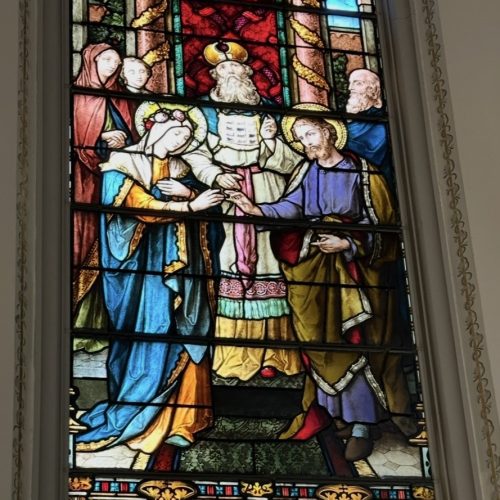
Betrothal of Mary and Joseph (stained glass in the Cathedral of the Immaculate Conception in Fort Wayne)

This poses a rhetorical question: Just as St. Joseph, her spouse, are we, as her children, in some way entitled to share in the gifts of our Blessed Mother? And through these gifts, participate in the life of the Holy Family? Is this the meaning of the lily that Our Lady offers us?

We will explore this in a subsequent article, but I want to leave you with a hint from John 19 (source USCCB)

25 Standing by the cross of Jesus were his mother and his mother’s sister, Mary the wife of Clopas, and Mary of Magdala.

26 When Jesus saw his mother* and the disciple there whom he loved, he said to his mother, “Woman, behold, your son.”

27 Then he said to the disciple, “Behold, your mother.” And from that hour the disciple took her into his home.

Here, we see Our Lady given to St. John as his Mother, and he given to Our Lady as her son. It is understood in Catholic tradition that St. John represents all Christians, and therefore, we are all spiritual children of the Blessed Virgin Mary! Our Lady, Mother of Christ, is also our mother! 

Our Lady, Patroness of America, is revealing that living the life of the Holy Family is the essential antidote to the secular culture of our day and the necessary foundation for us to say yes to Our Lady’s request: that we help her lead the world to peace. 


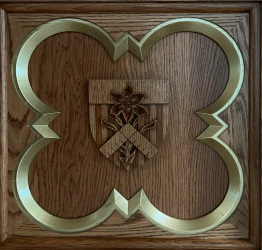
St Joseph symbology on the Altar at the Oratory of the Holy Family.

Read More